Thursday, September 11, 2014

The Face of Turkey


Making Turkish rugs by hand.  


Selling peppers in the mountain village of Sirince


Baking bread in Sirince, a scene that could have been 2000 BC.  The bread was delicious.  It was the only restaurant I've eaten in with a dirt floor, but oh the view across the Sirince hillside.


This lad was all too happy to play for me, after I handed over 1/2 lira, that is!


This man worked onyx.  I ended up buying six coasters for $15


No, I did not try one.  But they have cafés where one can rent a smoke and relax, the Turkish version of Starbucks.
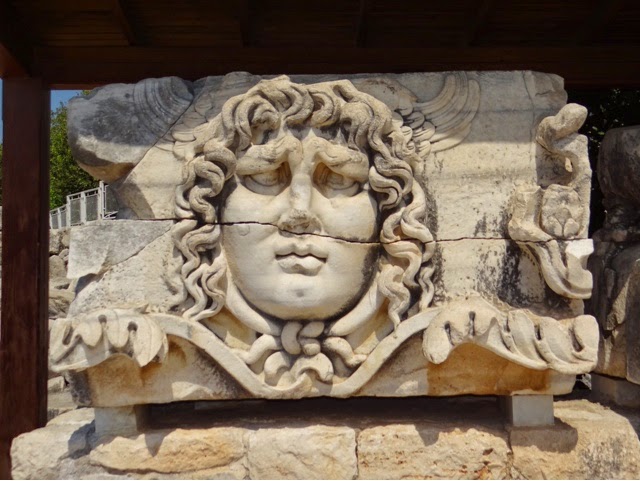

This remind you of anyone?

Monday, September 8, 2014

Goodby, or as they say here, αντίο


September 12 - Tomorrow we bid "adio" (Yes, that's what it is in Greek) to our two visitors.  Doyle heads to Crete, his field of labor, and Erica will be flying to Armenia for Special Meetings.  So Denita and I will be alone for the first time since we left Eugene.  Will she be able to take it?  It may be difficult to imagine that level of stress, but people can and do rise to the occasion.  Smile.  And we do have Mike and Sandra's arrival here on the 23rd to look forward to.


Wednesday, September 3, 2014

The Great Satan

September 3 - We visited the Great Satan yesterday.  Actually, we visited his little brother, the Little Satan, as well.  These are two beaches located on the western side of the island known in Greek as Micro Seitano and Megalos Seitano.  Mount Kerkis falls directly to the sea, and it is the one place on Samos where there are no roads.  It is about a mile hike to the first beach IF you park in the right place, which we did not, so it was about 1.5 miles for us.  We'll know better next time next time when we bring Mike and Sandra here.  

The first three pictures below show Micro Seitano, which I found quite spectacular, and the last picture shows Megalos Seitano, which is located at the end of a substantial gorge, and it is quite large and peaceful.


Sunday, August 31, 2014

Hymn 216

One of the things I miss about being in a mixed-language meeting is the simple joy of singing aloud with my brothers and sisters in Christ.  When we went to Sunday meeting in Mexico, you could always  sound out the words in the Spanish hymn book and sing along.  But Greek has it's own script, and although we can decipher the letters, by the time we get the sounds figured out, everyone else has moved on to the next verse.

I woke up one morning with the words of hymn 216 in my heart. "May thy perfect love, O Lord, burn strong within my heart, that I may in thy truth abide, and from all sin depart."  Denita and I decided to learn this hymn in Greek.  We started on this project last week, and have pretty well "mastered" the first verse and chorus.  So when Doyle asked in Greek this morning what I hoped was a hymn choice, I piped up with #216 in the English book.  It felt very good to be able to join in with everyone else and sing with gusto.

I hope the folks here like #216 as much as I do, as I think we'll be singing it a lot.  Smile.

Saturday, August 30, 2014

Laodicea

After leaving Pamukkale, we drove about five miles south and bumped into a sign along the road that said "Laodicea."  We were intending to tour Colosse, which was another ten miles down the road, but hey, who could resist seeing one of the Seven Churches of Revelation.  Needless to say, I love Turkey!!!!!!!!!  We found out later that Colosse, near the modern city of Honuz, is just an unexcavated mound, and so we spent all of our available time walking around Laodicea.

Laodicea was built on top of a low-lying hill, with the Lycus River on one side and another stream on the other.  It was pretty significant in its day.  There is an ampitheatre on the north which holds an estimated 12,000 spectators, and another on the west with seating for 8,000.  On the south is the largest stadium in Asia Minor, with the capacity to seat 20,000 spectators.
  
As you can see from the third picture below, the white cliffs of Pamukkale are visible across the Meander valley.  One would think this would have something to do with the message to the Laodicean church:  "I know thy works, that thou art neither hot nor cold: I would thou wert hot or cold. So then because thou art lukewarm, and neither hot nor cold, I will spue thee out of my mouth ....." (Rev. 3:15, 16).  The water flowing down the Pamukkale hillside is indeed lukewarm, neither hot nor cold.  It is very pleasant to swim in, but not to drink.  

This was the main gate to the city followed by Main Street

The reconstructed temple

The travertine cliffs of Pamukkale are visible across the valley.

Going native with the locals.  

Friday, August 29, 2014

Pamukkale

After touring the ruins of Ephesus, we went back to Kusadasi on the Turkish coast and spent the night.  The next day, we rented a car and drove three hours up the Meander River Valley.  (The twisting course of this river gave rise to the word "meander.")  Near Denizli, from a distance of about ten miles, we first saw the gleaming white travertine cliffs of Pamukkale.  The word means "cotton castle" in Turkish, and it is a pretty accurate description.  These pools of water cascading down the hillside would remind you of the Mammoth Hot Springs at the north end of Yellowstone.  There are 20 or 25 pools of water formed by the evaporation of calcium in the water, the same way a stalagmite is formed in a cave.  The pools have 3' to 5' walls where they adjoin the cliff, and then taper out to nil on the other side.  Very hard to explain, but they look for all the world like they are man-made.  The hillside is about 300' high.  You walk up part way, take your shoes off, and then you are in the warm water all the way to the top. 

Above Pamukkale are the ruins of Hieropolis.  This was a major city in the first and second centuries, and it is important in Catholic studies as the home of Papias, one of the earliest Catholic presbyters of whom we still possess writings. (Incidently, Eusebius, the fourth century church historian, had read Papias, and he commented that "he must have been a man of very low intelligence, to judge by his writings."  The mainstream of Catholicism had shifted that much in the intervening 200 years.)  Hieropolis was considered a holy city because of the "magical" springs and pools, and people came from all over to be healed.  There is a necropolis next to Hieropolis with over 1000 sepulcres.  The Turks built a pool over some ruins, and we got to swim amid the Greek columns just under water.

On the way down, the sun was coming in at a low angle, hitting the sulfur and iron deposits on the white rock.  It made the most amazing gold color.  I wondered if the camera would pick it up, but it did. 


Ephesus

August 26 - This week we made our first foray into Turkey.  I had no idea it was such an amazing country.  It is clean, modern and progressive; and blessed with an incredibly rich historical legacy. The people would remind you a lot of Americans.  However, in this country of 78 million people, there is not a single pair of workers.  Truly the need is great, and the fields white unto harvest.

Ephesus was the fourth largest city in the Roman Empire, possessing some 200,000 souls.  It was double the size of Jerusalem.  To see how astounding this is by historical standards, London and Paris did not reach this size until the 16th century.  In Paul's day it was a harbor town, situated right on the Aegean Sea.  Now, due largely to the silting up of the Cayster River, it lies about five miles from the sea.  The area between is rich, productive farmland.  The upper part of the city lies between two hills, and the lower part was right on the ocean.  The two parts were connected by a gleaming road of marble, with statues on both sides.  I paced it off, and it is 20' to 25' wide, wider than many Greek streets today.

The story of the Gospel in Ephesus begins in Acts 18:19.  Paul came to the city, left his companions there, went to Jerusalem, and came back.  In his absence, Apollos, Aquila and Priscilla moved there. Although he had an imperfect understanding, Apollos was teaching Christ in the synagogues.  He was Jewish, as was the initial nucleus of believers.  Paul's stayed there two full years, and the mission yielded spectacular results among the Greeks.  Perhaps he alludes to the miracle of the Gospel  bringing the two peoples together in Ephesians 3:14.  "For he is our peace, who hath made both one, and hath broken down the middle wall of partition between us."

The first two pictures below show the amphitheatre which was the setting for Acts 19:23ff.  Paul's companion's, Gaius and Aristarchus, were hauled there to face the wrath of the silversmiths.  "Great is Diana of the Ephesians," the mob shouted for two hours.  The acoustics are superb in the theater, and it would have been incredibly intimidating.  The theater is scooped into the hillside in the lower city, not far from the harbor.  The current design holds about 25,000 people, larger than in Paul's day.  It had been expanded up the hillside in the second century.  Autzen Stadium was likewise renovated a few years ago to seat more than the 50,000 rabid Duck fans it used to hold.

Eight or ten years later, the Spirit, through the apostle John, had a message for the Ephesian church, Revelation 2:1-7.  He compliments them on their labor and patience, and for their discernment in rejecting the false apostles who had come their way.  These were the circumcising missionaries who were telling the gentile believers they had to keep Torah to be saved (see 2 Cor. 11:3, 4, 13ff).  But they had lost their first love, and their zeal for the things of God had cooled.  Paul had also admonished them to "walk in love" and reminded them of the necessity of being "rooted and grounded" in love.  "That Christ may dwell in your heart by faith; that ye, being rooted and grounded in love, may be able to comprehend with all saints what is the breadth, and length, and depth, and height; and to know the love of Christ, which passeth knowledge ....." (Eph 5:2, 3:17-19)


The amphitheatre where they shouted, "Great is Dianna of the Ephesians."

Another view of the ampitheater

The library of Celsus

The view from the upper city down the marble roadway to the lower city

The public latrines

I didn't find Dianna of the Ephesians to be all that great.

The foot incised in marble.